
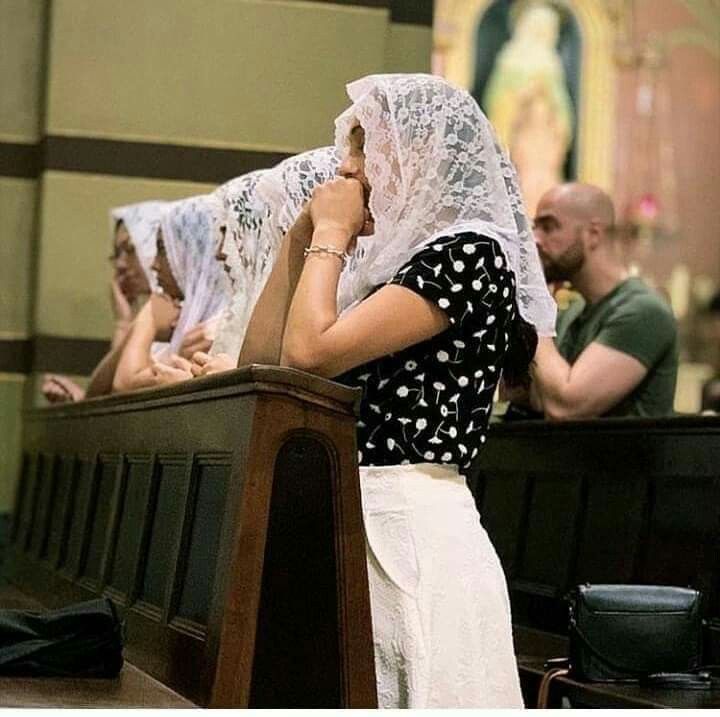
Why did St. Paul command women to cover their heads in worship, and what does that mean for the Church today? For many, this passage in 1 Corinthians 11 feels like a cultural artifact, but Scripture, the Church Fathers, and two millennia of Christian practice tell another story. Far from being a relic of the past, head coverings embody transcendent truths: creation order, sacramental symbolism, reverence before the angels, and continuity with the apostolic and catholic faith. This post explores the biblical foundation, patristic testimony, historical practice, and the modern challenge of recovering this ancient sign of reverence.
Scripture: St. Paul’s Full Teaching
When St. Paul addresses head coverings, he doesn’t give us a passing remark. He devotes a whole section in his letter to Corinth:
2 Now I commend you because you remember me in everything and maintain the traditions even as I delivered them to you. 3 But I want you to understand that the head of every man is Christ, the head of a wife is her husband, and the head of Christ is God. 4 Every man who prays or prophesies with his head covered dishonors his head, 5 but every wife who prays or prophesies with her head uncovered dishonors her head, since it is the same as if her head were shaven. 6 For if a wife will not cover her head, then she should cut her hair short. But since it is disgraceful for a wife to cut off her hair or shave her head, let her cover her head. 7 For a man ought not to cover his head, since he is the image and glory of God, but woman is the glory of man. 8 For man was not made from woman, but woman from man. 9 Neither was man created for woman, but woman for man. 10 That is why a wife ought to have a symbol of authority on her head, because of the angels. 11 Nevertheless, in the Lord woman is not independent of man nor man of woman; 12 for as woman was made from man, so man is now born of woman. And all things are from God. 13 Judge for yourselves: is it proper for a wife to pray to God with her head uncovered? 14 Does not nature itself teach you that if a man wears long hair it is a disgrace for him, 15 but if a woman has long hair, it is her glory? For her hair is given to her for a covering. 16 If anyone is inclined to be contentious, we have no such practice, nor do the churches of God.
St. Paul grounds this in creation (vv. 3, 8–9), worship (v. 5), nature (vv. 14–15), angels (v. 10), and catholic practice (v. 16). This is far more than cultural custom.
The Apostolic Logic in 1 Corinthians 11
St. Paul’s words may sound strange to modern ears, but his reasoning is clear and deeply theological. He is not offering a cultural aside but grounding the practice in transcendent realities:
- Creation Order: “The head of every man is Christ, the head of a wife is her husband, and the head of Christ is God” (v. 3). Headship here does not mean domination, but order. Just as Christ submits to the Father, so in worship the created order is acknowledged and honored.
- Theological Symbolism: Christianity is a sacramental faith. The invisible is made visible through material signs. Baptism is not “spiritual only” — it requires water (the only exception being martyrdom as a baptism of blood). The Eucharist is not “symbol only” — it requires bread and wine, not cookies and Kool-Aid. Ordination is not theoretical — it requires hands laid upon the head, not a remote prayer over Zoom. The Church does not replace apostolic signs with convenient substitutes. In the same way, reverence in worship is not left to vague feelings but is embodied in a visible sign: the covering of the head.
- The Angels: St. Paul writes: “That is why a wife ought to have a symbol of authority on her head, because of the angels” (1 Corinthians 11:10). This is not a throwaway line — it is one of the most mysterious and profound reasons he gives. Our worship is cosmic, not casual, and the veil signals that awareness.
Angels Are Present in Worship
St. Paul teaches that when we gather, we come into the presence of heaven itself: “You have come to Mount Zion and to the city of the living God, the heavenly Jerusalem, and to innumerable angels in festal gathering” (Hebrews 12:22).
Revelation shows the same truth — Christian worship joins the angels and saints before God’s throne (Revelation 4–5).
A Matter of Reverence
The Fathers took this line seriously. St. John Chrysostom warned that ignoring the veil insults the angels who stand with us in worship. The veil is not just about human order, but about heavenly reverence.
In our liturgy, when we cry “with angels and archangels and all the company of heaven,” the head covering becomes a visible recognition that worship is cosmic.
Order and Obedience
Angels model obedience and ordered worship before God. Veiling reflects this order — what St. Paul calls a sign of exousia (authority). In the presence of the angels, this visible recognition of God’s order is especially fitting.
A Reminder of Rebellion
In the background is also the Genesis 6:1-8 fiasco — the “sons of God” who rebelled and took the “daughters of men.” This dark story of angelic rebellion and sexual disorder loomed large in Jewish thought. To veil in worship is, in part, to acknowledge this history — to stand humbly, modestly, and in obedience where once there was transgression.
The covering of the head declares: worship is not a place of disorder or rebellion, but of order, chastity, and holiness before God and His angels.
For St. Paul, then, the veil is no trivial custom. It embodies reverence before the angelic host, humility before creation’s order, and vigilance against the distortions of rebellion. It proclaims that our worship is joined to the heavenly liturgy where Christ is enthroned.
- Catholic Practice: “If anyone is inclined to be contentious, we have no such practice, nor do the churches of God” (v. 16). St. Paul appeals to the common practice of all the churches — this is catholic, not local.
This is why head coverings cannot be dismissed as merely “cultural.” To treat them that way undermines the very logic St. Paul uses here. And once you start dismissing apostolic commands as “cultural,” there is no principled reason not to dismiss others. This is exactly how The Episcopal Church and other denominations have justified women’s ordination, homosexual practice, and transgender ideology. They claim St. Paul was simply reflecting the biases of his time. But if his instructions about worship are cultural, why not his teaching on sexuality? Why not his instructions on ordination?
To take St. Paul seriously means to take his reasoning seriously. The covering of the head in worship is a sign of reverence, order, and cosmic awareness. To abandon it is not liberation — it is innovation.
The Witness of the Fathers
- Tertullian (c. 200 AD): “So, too, did the Corinthians themselves understand [St. Paul]. In fact, at this day the Corinthians do veil their virgins. What the apostles taught, their disciples approve.” (On the Veiling of Virgins, ch. 8)
Tertullian shows that the early Church at Corinth was still practicing what St. Paul commanded — even extending veiling beyond wives to virgins.1
- St. Clement of Alexandria (c. 200 AD): “Let the woman observe this, further. Let her be entirely covered, unless she happen to be at home. For that style of dress is grave, and protects from being gazed at. And she will never fall, who puts before her eyes modesty, and her shawl.” (The Instructor, Book 3, ch. 11)
Clement ties veiling to modesty and reverence — the veil is a protection and a visible sign of chastity and seriousness in worship.2
- St. John Chrysostom (c. 400 AD): “The woman ought to be covered, because of the angels… Do you see how many reasons St. Paul has given? The command is of God; the woman is the glory of the man; creation declares it; the angels are present. If you despise the covering, you offend God, you bring shame to man, you mock nature, you insult the angels.” (Homilies on First Corinthians, Homily 26)
Chrysostom piles up reasons: God’s command, creation, nature, the presence of angels. For him, ignoring the veil is not a small matter but an offense against all these realities.3
- St. Augustine (c. 400 AD): “It is not becoming even in married women to uncover their hair, since the apostle commands women to keep their heads covered.” (On Holy Virginity, ch. 20)
Augustine takes St. Paul’s words as binding on all Christian women, not just cultural advice for Corinth.4
- St. Jerome (c. 400 AD): “It is usual in the churches for virgins to be veiled, and it is a token of modesty.” (Letter 147 to Pope Damasus, cf. Letter 22 to Eustochium)
Jerome treats veiling as the catholic norm — an expected sign of modesty in the worship of the Church.5
The Fathers speak with one voice: St. Paul’s words are not cultural, but binding, universal, and rooted in apostolic tradition.
History and Continuity
1st Century – St. Paul’s command (1 Corinthians 11:2–16):
The practice begins with apostolic authority, rooted in creation, worship, and the presence of angels.
2nd–3rd Centuries – Tertullian and Clement:
Early Fathers extend St. Paul’s words beyond wives to include virgins, showing it was not a narrow or cultural instruction.
4th–5th Centuries – Chrysostom, Augustine, Jerome:
The Fathers assume veiling as universal and catholic practice. It is simply what Christian women did in worship.
Middle Ages:
The practice continued without interruption in both East and West. Veiling was part of the fabric of Christian worship.
Reformation (16th Century):
Even when reforming liturgy and doctrine, the Reformers did not discard veiling. Anglicans, Lutherans, and Reformed alike retained the practice.
19th–20th Centuries:
In Roman Catholicism, veiling was codified in canon law (1917).6 Among Protestants, women still wore hats or coverings to church as the cultural expression of the same principle.
Post-1960s West:
Only in the wake of Vatican II and wider cultural shifts did veiling decline in the West. Second-wave feminism, in particular, portrayed the veil as oppressive rather than reverent, and many churches capitulated to that narrative. Yet it remains normative in Eastern Orthodoxy and in much of the Global South.
Answering an Objection: What About 1 Peter 3?
Some object by pointing to St. Peter’s words:
“Do not let your adorning be external—the braiding of hair and the putting on of gold jewelry, or the clothing you wear—but let your adorning be the hidden person of the heart with the imperishable beauty of a gentle and quiet spirit, which in God’s sight is very precious.” (1 Peter 3:3–4)
They say: “See? That was cultural. Women today braid their hair and wear jewelry, and the Church no longer objects. So, head coverings must also be cultural.”
But this misreads St. Peter. His concern is not fashion in itself, but socio-economic display. In the Roman world, braided hair and gold jewelry were outward signals of wealth and status. St. Peter calls Christian women away from ostentation and toward modesty — adorning themselves with the inner beauty of holiness.
The principle here is transcultural, even if the specific expression varies. In every age, Christians are called to modesty, humility, and holiness rather than status-seeking. That doesn’t mean St. Peter’s words can be discarded; it means we discern how the principle applies today.
St. Paul and St. Peter both give us apostolic commands rooted in transcultural truths: reverence, modesty, created order, and holiness in worship. The Church has always recognized the difference between a passing custom and a catholic sign. Baptism requires water; Eucharist requires bread and wine; ordination requires the laying on of hands. And in worship, St. Paul says, head coverings are not an optional custom but a visible sign “because of the angels” (1 Corinthians 11:10).
And here is the danger: if we treat St. Paul’s words as cultural relics, we create a habit of setting aside apostolic teaching whenever it feels out of step with the times. Once that principle is admitted, there is no limiting it — the authority of Scripture is gradually hollowed out. The argument is the same: “That was just cultural.” But the moment you treat the apostolic witness as culture-bound, its authority collapses.
Closing Reflection
In a time when so much of the Church’s visible witness has faded, perhaps this small act of obedience can speak loudly: our worship is not casual, but cosmic. Heaven is present. And our bodies, even in how we dress, proclaim that truth.
In the West, second-wave feminism often reframed St. Paul’s command as oppressive, turning a sign of reverence into a supposed symbol of inequality. But the Fathers and the continuous practice of the Church tell a very different story: veiling is not about suppressing women but about honoring God, His created order, and the holiness of worship.
To recover it today is not a step backward into legalism, but a countercultural act of fidelity — a witness that in Christ, reverence is freedom.
Further Reading
- David W. J. Gill, “The Importance of the Veil in 1 Corinthians 11:2–16,” Tyndale Bulletin 41.2 (1990): 245–260.
- Michael Marlowe, Headcovering Customs of the Ancient World (Bible Research, 2004).
- Thomas C. Oden, Ancient Christian Commentary on Scripture: 1–2 Corinthians (Downers Grove: IVP Academic, 1999).
- R. C. Sproul, The Role of Women in the Church (P&R Publishing, 1983).
- Orthodox Church in America, “Why Do Orthodox Women Wear Head Coverings in Church?” (OCA.org, 2007).
- Anglican Catholic Church, Statement on Head Coverings in Worship (ACC Synod, 2009).
- Tertullian, On the Veiling of Virgins, ch. 8, in Ante-Nicene Fathers, Vol. 4, eds. Alexander Roberts & James Donaldson (Peabody: Hendrickson, 1994). ↩︎
- St. Clement of Alexandria, The Instructor (Paedagogus), Book 3, ch. 11, in Ante-Nicene Fathers, Vol. 2, eds. Alexander Roberts & James Donaldson (Peabody: Hendrickson, 1994). ↩︎
- St. John Chrysostom, Homilies on First Corinthians, Homily 26, in Nicene and Post-Nicene Fathers, First Series, Vol. 12, ed. Philip Schaff (Peabody: Hendrickson, 1994). ↩︎
- St. Augustine, On Holy Virginity, ch. 20, in Nicene and Post-Nicene Fathers, First Series, Vol. 3, ed. Philip Schaff (Peabody: Hendrickson, 1994). ↩︎
- St. Jerome, Letter 147 to Pope Damasus and Letter 22 to Eustochium, in Nicene and Post-Nicene Fathers, Second Series, Vol. 6, eds. Philip Schaff & Henry Wace (Peabody: Hendrickson, 1994). ↩︎
- Codex Iuris Canonici (1917), canon 1262 §2: “Men, in a church or outside a church, while assisting at sacred rites, shall be bareheaded, unless the approved customs of the people or particular circumstances determine otherwise; women, however, shall have a covered head and be modestly dressed, especially when they approach the table of the Lord.” ↩︎